Gather the midnight strands, tend the roots that gave you life, weave hopes into pathways― paths that lead you home.
Day after day, Nemy sows seeds, pulls weeds, and strips leaves in the sugarcane plantation where she is enslaved. But one night, she follows a woman called Big Mother to a hidden shack. There, she finds a group of women braiding each other's hair. But these are no ordinary braids. Hidden in each elaborate pattern is a secret―a message signaling their intent to flee and a map to guide them in their escape. Will the paths these courageous women weave bring Nemy to a new home where she can be free?
A picture book of love, liberation, and legacy inspired by the true story of enslaved African women in Colombia braiding maps to freedom.---from the publisher
32 pages 978-1915244802 Ages 6-10
Keywords: women's history, courage, freedom, slavery, South America, hair, maps, 7 year old, 8 year old, 9 year old, 10 year old, African American and Black stories, African American author, diverse books
*********
Every library NEEDS this book. Fantastic!
Freedom Braids is the story of a young girl named Nemy who lived in Columbia on a plantation that harvested sugar cane. The author's note explains her story is based on people who were taken from Africa and enslaved in North and South America. In Nemy's case, she escapes with a group of women led by one known as "Big Mother," a slave who leads them to freedom.
The braids the women wove in their hair represented paths to freedom, and even where Spanish troops were encamped. A style called "El Undihito" was used for women who hid gold and seeds in their braids, These seeds were transported and used to plant crops when they arrived on free soil. The people fled to the mountains where they could hide in the dense forests in freedom. They built "palenques," or communities, and often would help others escape to join them.
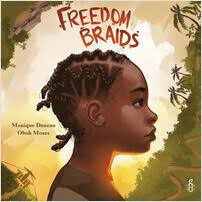
Beautiful art by Oboh Moses captures the women braiding each other's hair by the light of a fire. In one spread, the darkness of the forest at night is stunning in black and colors of dark blue. As the page turns, it is sunrise as Nemy looks to the mountains, the back of her head dominant to highlight her braids that zigzag like the river in front of her. The dark blues and black are replaced by hues of purple, pink and green with a blue river winding down the mountain. Nemy and the women reach freedom, "And in the light of a new dawn, she found a way home."
It is a rare experience to encounter such a powerful picture book. Its beauty is only eclipsed by the amazing story told by a master storyteller, Monique Duncan. The end pages feature each of the braided hairstyles.
Freedom Braids is a MUST HAVE, MUST READ for everyone of all ages. Libraries should plan on purchasing multiple copies as this will be a popular check-out.
Recommended by: Thompson McLeod (Pamela), Librarian and Blogger, Florida USA
See more of her recommendations: http://booksbypamelathompson.blogspot.com/
********
Day after day, Nemy scattered seeds, pulled weeds and stripped leaves in the sugarcane fields of Colombia, while all around her children, women and men laboured just as hard, prisoners and slaves of the landowners who believed it was okay to treat those with a different coloured skin as property rather than people. As Nemy went about her daily work, her hands grew hard and calloused but her eyes watched Big Mother as she cut the cane by day, cooked yuca roots for supper and then told stories before bed. One night, Nemy follows Big Mother to a small shack where she not only discovers a group of women gathered around a fire, but watches them braid each other's hair.
But these are no ordinary braids, and it is a night that is to change Nemy's life forever... For in those hairstyles warnings are woven, and roads to travel and rivers to cross are plaited, twisted and knotted, in secret patterns known only to those who know.
Based on the Transatlantic Slave Trade era (c. 1526 - 1867). when millions were captured from African countries and taken to North and South America to work in harsh, cruel, unpaid conditions as free labour for European masters, this is a story that sheds a light on not just the risks that people were willing to take to be free, but that indelible belief that they should and could be.
It tells of the ingenuity of the women who braided hair, just as their mothers, grandmothers, great-grandmothers and their ancestors had done "thousands of miles away and thousands of years ago". But these were no ordinary, random hairstyles, because embedded in the intricate cornrows were maps to freedom, each style indicating something special - and each identified on the endpages and explained in the back matter.
Set in Colombia, South America and based on the community of San Basilio de Palenque, a walled village that was established by Benkos Biohó to provide safe haven for the escapees, it brings the "big story" of the slave trade into the realm of the younger reader through Nemy, its storyline and the emotive illustrations, portrayed in a dark, but not sinister palette, until the women reach sanctuary.
As a quilter, I have heard of the Underground Railroad stitched into the intricate patterns of quilts that were hung on clotheslines as maps to freedom, but this concept of using a hairstyle was new to me until I read and reviewed The Magic Callaloo and then explored all the rabbit-holes that that led me down. But this could be so much more than Nemy's story, or even that of the women she represents, particularly in these times when politicians and the profit-driven seem to be closing borders to those trying to flee modern-day oppression and poverty. It could lead to considering that ingrained need and right of every human to be free to make their own lives their choices; to investigating what might be happening in a particular country that forces people to pack up and flee, preferring the uncertainty of the unknown to the reality of the known; to developing empathy and compassion for those who have done so. Because it is only through hearing stories like Nemy's and delving deeper that we can move from the selfish here-and-now mentality that seems to predominate to the what-has-been and what-could-be that has to be the way forward.
The book itself is shared by the publishers here, and there is also an interview with the author here.
Recommended by: Barbara Braxton, Teacher Librarian, New South Wales AUSTRALIA
See more of her recommendations:
500 Hats http://500hats.edublogs.org/
The Bottom Shelf http://thebottomshelf.edublogs.org/