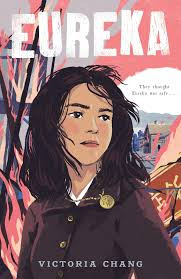
******** “People come in diff’rent sizes
Colors, shapes and names
Tho’ we're diff’rent on the outside
Inside I think we’re the same!
– Peter Alsop, “Kid’s Peace Song” (1986)
November 5, 1884
“I don’t want to go.
‘You have to go,’ says Ma Ma.
‘If you stay here,
you won’t be safe,’
says Ba Ba.
‘San Francisco’s getting
more and more dangerous
for Chinese people.
You
must
go.’
I don’t want to go.
‘I’m safe here with
you’ I say.
Ma Ma tries to
stand up.
Her face bends
in pain as she
leans over to
rest.
‘Sit,’
says Ba Ba.
Ma Ma sits back
down, and I am suddenly
amazed by her
smallness.
She lifts her feet
back up on the lounge,
little lotus feet,
each one only
two inches long,
each broken toe
like a lotus flower petal,
soft
and
beautiful.
I don’t want to go.
Ma Ma and Ba Ba
want me to
move to Eureka!
Almost three hundred miles north of
San Francisco, the only
home I’ve ever known.
They say it’s safer there,
that a judge just said
schools must let Chinese
kids like me go to school with
the white kids.
‘This is for you,’ says Ma Ma
as she pulls
out a necklace,
bright yellow gold,
from a tin box.
‘Real gold,’ she says.
I don’t want to go.
A round circle hangs
from the necklace, with a Chinese
character in the middle,
愛, ‘love.’
‘When you’re scared,
touch the necklace, and you will
feel my love,’ says Ma Ma.
‘And you will feel brave.’
She waves me over
and I move closer to her.
She drops the necklace over
my head.
It slides over my hair
onto my shoulders,
settles around my neck.
I don’t feel brave.
It just feels
like a gold stone that
pulls me down.
Ma Ma places her palm on
my heart,
closes her eyes.
A tear hangs on her
eyelashes, drops
down and
catches her cheek,
bleeds down
her face, and then
so many tears,
they all
become
one.
A drop
lands on my hand,
mixes with my own tears.
I don’t want
to go.”
EUREKA is an exceptional piece of historical fiction for tweens. Beginning with a “Content warning: This book contains violence and racism,” we see the White majority on the West Coast terrorizing and uprooting Chinese Americans.
“President Trump unleashed a xenophobic tirade against Somali immigrants on Tuesday, calling them ‘garbage’ he does not want in the United States in an outburst that captured the raw nativism that has animated his approach to immigration.”
– NYT (12/02/2025)
As a student of American history (and current events), it’s hard to shake the belief that the normal state of affairs in the U.S. of A. over the past 250 years has, time and time again, involved attacking or taking advantage of immigrants, women, or anyone else who is not a straight White European male.
“‘They said they’ll hang
us on the new gallows they’re
building right now, if we’re
still here after three tomorrow,’
Uncle Wong says between
breaths.
‘We have to go, now!’
People are running everywhere,
back and forth in the streets,
packing their things,
talking loudly.
I’m so scared,
I can’t move.
My body weighs as much
as the trees.”
As Victoria Chang explains in her Author’s Note:
“On May 6, 1882, the US government signed the Chinese Exclusion Act, which prohibited all immigration of Chinese laborers for ten years (and was extended and made permanent in 1902). This was the first major US law that prevented a specific nationality from immigrating. The act represented years of racial tensions, violence, and hostility by the government
and white Americans toward Chinese immigrants.”
EUREKA begins two years after that enactment, and includes a horrific Chinese American “expulsion” in Eureka, California (which did, in fact, take place). The Chinese Exclusion Act apparently made Whites feel that they had government sanctioning to maim, kill, and burn down Chinese-American neighborhoods.
Given what was going on in San Francisco’s Chinatown in those dangerous days, Mei Mei’s parents, and other parents believed that Eureka would be a safer place for their Chinese American kids. This certainly does not turn out to be true. Twelve-year-old Mei Mei gets sent up there, gets stuck slaving in a White family’s kitchen, and not getting to go to school. Through her eyes and her story-in-verse, readers get a vivid picture of the hatred and violence surrounding her.
“Kids like us live everywhere
Around the world, in ev’ry land
The words we speak are not the same
But Peace on Earth we understand”
A generation after Peter Alsop encouraged kids to see beneath the skin colors and other surficial differences, things still don’t seem much better.
Exposing young readers to books like this enlightens them and helps break the spiral of hate that continues to be passed down from parents to their children. Let’s hope that something miraculously happens in 2026 to rid us of today’s continued ignorance and prejudice against immigrants.
That’s my New Year’s wish.
Recommended by: Richie Partington, MLIS, California USA
See more of Richie's Picks http://richiespicks.com/> http://richiespicks.pbworks.co