
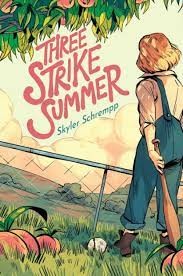
Sandlot meets Esperanza Rising in this lyrical middle grade novel set in the 1930s about a strong-willed girl who finds her voice in a tale of moxie, peaches, and determination to thrive despite the odds.
When the skies dried up, Gloria thought it was temporary. When the dust storms rolled in, she thought they would pass. But now the bank man’s come to take the family farm, and Pa’s decided to up and move to California in search of work. They’ll pick fruit, he says, until they can save up enough money to buy land of their own again.
There are only three rules at the Santa Ana Holdsten Peach Orchard: No stealing product. No drunkenness or gambling. And absolutely no organizing.
Well, Gloria Mae Willard isn’t about to organize any peaches, no ma’am. She’s got more on her mind than that. Like the secret, all-boys baseball team she’s desperate to play for, if only they’d give her a chance. Or the way that wages keep going down. The way their company lodgings are dirty and smelly, and everyone seems intent on leaving her out of everything.
But Gloria has never been the type to wait around for permission. If the boys won’t let her play, she’ll find a way to make them. If the people around her are keeping secrets, then she’ll keep a few of her own. And if the boss men at the Santa Ana Holdsten Peach Orchard say she can’t organize peaches, then by golly she’ll organize a whole ball game.---from the publisher
320 pages 978-1-5344-9914-0 Ages 10-13
Keywords: historical fiction, 20th century, finding your voice, girls and women, gender equality, baseball, sports, prejudice, 10 year old, 11 year old, 12 year old, 13 year old, determination, Great Depression, Dust Bowl, American history, social activist, poverty, homelessness, lower income
***************
“And the little screaming fact that sounds through all history: repression works only to strengthen and knit the repressed.”
― John Steinbeck, THE GRAPES OF WRATH
“Going down the road feeling bad,
Don't wanna be treated this a-way”
– traditional tune featured in the 1939 movie, “The Grapes of Wrath”
“I saw Pa take the set of papers and sign once, twice, three times. And I could feel Ma looking over my shoulder, watching it happen, too, not cracking, not crying.
And then it was done. I saw it in Pa’s shoulders. I felt it in Ma’s arms. And I heard a howling start in my ribs.
‘Shh, Glo, shh,’ Ma whispered, cooing now like she would for a little baby, rocking back and forth like she could ease the storm out of me.
But the farm was gone.
And Ma had held me back. My lungs felt like they were made of fire. And something was heaving up in me that I had to get out. Something red and raw and violent.
‘It’s all right, Glo,’ Ma said. ‘You cry it out now. I got you.’
Her words made me want to retch. I held still for just a moment for her to think I was done fighting, and her arms slackened just a little. With one thrust of my shoulder I broke free and scrambled out the back door, running away from Pa and the bank man’s papers, bounding out into the blinding sun and over the dry, dead dirt.”
Whether she likes it or not, Gloria Mae Willard, along with her big sister Jess, and their parents, are headed to California. The wheat is long dead, her baby brother is recently dead, and the bank will be having their ramshackle home torn down once they are gone. An aspiring baseball player with impressive pitching talent, Gloria takes revenge on the bank man’s fancy car–a perfect strike from the woods, where she can’t be seen–before the now pissed-off bank man makes sure they are off of what has now legally become the bank’s farm.
THREE STRIKE SUMMER is going to be a big hit with young people who are drawn to fiction featuring American history and social justice. Gloria and her family end up laboring at an enormous peach orchard in California. They join the other migrants working there who are being taken advantage of. They are compelled to rent an exorbitantly-priced cabin in which to live, and to purchase their groceries at ridiculously inflated prices from the company store. After deductions for these living costs, the wages paid are so low that Gloria’s family and the other workers can barely survive. And any talk about organizing is met with beatings and ejection from the premises.
Meanwhile, Gloria meets the boys from the camp who have a makeshift baseball team and periodically sneak out to play against the young people from the nearby apricot orchard. They are down a player after one of the boys’ fathers was beaten up and booted from the orchard for attempting to organize, so she makes a play for joining their team. Gloria is a tough cookie who schemes and persists until, eventually, she gets her chance to play, and wins the respect of her new teammates.
A great introduction to the Dust Bowl, equality in sports opportunity, and labor organizing, THREE STRIKE SUMMER is an extra-bases hit.
Recommended by: Richie Partington, MLIS, Callifornia USA
See more of Richie's Picks <https://richiespicks.com/> https://richiespicks.pbworks.co