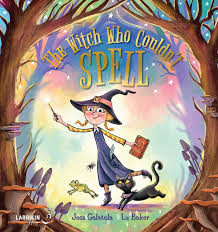
Wanda Spelled is a little witch with a BIG problem. At Spell Bright Academy, her magic is marvelous ... until her spelling slips.
Her disastrous spells cause a polar bear at the zoo to bare it all and creates a whale of a time in the classroom! Wanda’s well-meaning mix-ups cause mayhem! But can working on her spelling teach her that mistakes can lead to confidence?
Full of fun, wordplay, and heart, The Witch Who Couldn’t Spell celebrates the joy of learning, the fun of phonics, homophones, homonyms and the power of perseverance!---from the publisher
32 pages 978-1923345256 Ages 4-7
Keywords: witch, academy, spelling, magic, humor, fun, homophones, homonyms, perseverance, 4 year old, 5 year old, 6 year old, 7 year old, Halloween, wordplay, Language Arts Curriculum
*******
"Wanda Spelled was one of the most talented witches at the Spell Bright Academy." But, although her magic was excellent, she had difficulties when it came to spelling - the kind where you put the letters of a word in order so others can understand your thoughts - and so her spelling - the kind where princes are turned into frogs - often resulted in unforeseen, somewhat disastrous endings, each of which is delightfully depicted in Lu Baker's hilarious illustrations.
So when she confuses "bare" with "bear" she creates an embarrassing incident when the class visits the zoo, and when she confuses "creek" with "creak" when she tries to fix the library door, she causes chaos rather than the quiet she intended.
And so the reader is taken through an hilarious week in the world of Wanda where, despite what they might think about the necessity to spell correctly, the consequences of not doing so are made very clear, particularly when Wanda is summoned to the principal's office after a major mishap at the whole school assembly. But rather than being in BIG trouble the principal shows Wanda a strategy to help her get her words right "before someone gets hurt."
In an interview, author Jess Galatola explains that as a teacher, she sees kids struggling with spelling all the time, particularly those that can't be decoded or "sounded out" because English is an amalgam of so many languages. But although "sometimes we have to learn a word and move on", there are strategies we can learn to help ourselves particularly if we are patient and persevere as Wanda did. By placing her focus on playing with homophones and homonyms - both of which are cleverly distinguished on the front endpaper - Galatola emphasises the potential repercussions if we don't choose the right combination of letters. Even if the weekly spelling list and subsequent test, and Look, Say, Cover, Write, Check strategies have been replaced by text-speak, abbreviations and spellcheck, there is still a need for an accepted universal system that ensures our thoughts can be understood over space and time.
But as our young writers develop their knowledge and skills and discover the vagaries, nuances and fun of our language, let them create their own fun by choosing their own homophone/homonym combinations and letting their imaginations go as wild as Lu Baker's to build word awareness and a wonderful wall display!
Recommended by: Barbara Braxton, Teacher Librarian, New South Wales AUSTRALIA
See more of her recommendations:
500 Hats http://500hats.edublogs.org/
The Bottom Shelf http://thebottomshelf.edublogs.org/