The English alphabet has just 26 letters, yet there are 44 phonemes (perceptually distinct units of sound) that make up the words we speak, making the teaching of reading and writing with a primary emphasis on phonics or "sounding it out" tricky at best, Many will be familiar with "ghoti" which is "fish" spelt from the sounds of 'enough', 'women' and 'nation' and T. S. Watt's poem which begins
I take it you already know Of tough and bough and cough and dough? Others may stumble, but not you, On hiccough, thorough, lough and through? Well done! And now you wish, perhaps, To learn of less familiar traps?
is common visitor to Facebook feeds, while The Chaos written in 1922 by Gerard Nolst Trenité has over 800 irregularities in both spelling and pronunciation.
So how can we help our young readers make sense of this language that is constantly changing and evolving as words are added, fall out of use or have their meanings changed entirely?
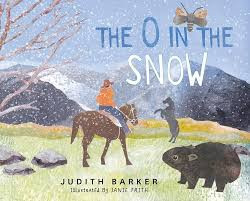
In this series of seven books (to date) young readers are introduced to the various spellings of a particular sound by taking them on a journey through a particular Australian landscape. For example, The O in Snow is inspired by The Man from Snowy River and celebrates the creatures of the High Country and the drovers that once mustered horses and cattle on the high plains, while The AU in Dinosaur follows the journey of several young Australians on a time travel ride back to see real dinosaurs and other prehistoric creatures..
In each book, the particular sound is highlighted in all its guises each time it appears, and Janie Frith's stunning illustrations bring the whole to life so that even if the emphasis is not on the phonic awareness, the reader is still introduced to the Australian landscape and its inhabitants, and the teaching notes which accompany some of them offer ideas for exploring the many layers of each. For example, The O in Snow covers the relationship to the original poem as well as the Indigenous language and heritage of the Alpine High Country; the annual journey of the bogong moth; the Snowy-Hydro Scheme (and its current extension); renewable energy; the natural inhabitants of both the Monaro and the high country; the threats they face and the controversial current treatment of the brumbies; as well as developing vocabulary, listening to the original poem and the movie's musical score (add in the Wallis and Matilda version) and a variety of creative arts, giving it a broader audience than those coming to grips with the peculiarities of the language.
But, if that is your main focus, then challenge students to build their own version of The Chaos by seeing how many of the 800 irregularities they can find. Here's a kickstart...
Our Strange Lingo When the English tongue we speak. Why is break not rhymed with freak? Will you tell me why it's true We say sew but likewise few? And the maker of the verse, Cannot rhyme his horse with worse? Beard is not the same as heard Cord is different from word. Cow is cow but low is low Shoe is never rhymed with foe. Think of hose, dose, and lose And think of goose and yet with choose Think of comb, tomb and bomb, Doll and roll or home and some. Since pay is rhymed with say Why not paid with said I pray? Think of blood, food and good. Mould is not pronounced like could. Wherefore done, but gone and lone - Is there any reason known? To sum up all, it seems to me Sound and letters don't agree
(Author in doubt)
This review can also be found here.
36 pages 9781925868609 Ages 7-10
Keywords: English language, how things work, stories in verse, 7 year old, 8 year old, 9 year old, 10 year old, Language Arts Curriculum
Recommended by: Barbara Braxton, Teacher Librarian, New South Wales AUSTRALIA
Editor's note: This series is available in Australia
Also in this series:
The O in Snow series
9781925868609
9781922800381
9781922800077
9781922800787
9781925868821
9781925868180
9781925868401