
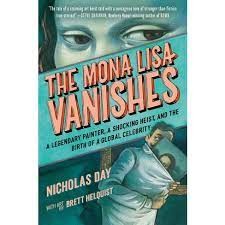
A propulsive work of narrative nonfiction about how the Mona Lisa was stolen from the Louvre, how the robbery made the portrait the most famous artwork in the world—and how the painting by Leonardo da Vinci should never have existed at all.
On a hot August day in Paris, just over a century ago, a desperate guard burst into the office of the director of the Louvre and shouted, La Joconde, c’est partie! The Mona Lisa, she’s gone!
No one knew who was behind the heist. Was it an international gang of thieves? Was it an art-hungry American millionaire? Was it the young Spanish painter Pablo Picasso, who was about to remake the very art of painting?
Travel back to an extraordinary period of revolutionary change: turn-of-the-century Paris. Walk its backstreets. Meet the infamous thieves—and detectives—of the era. And then slip back further in time and follow Leonardo da Vinci, painter of the Mona Lisa, through his dazzling, wondrously weird life. Discover the secret at the heart of the Mona Lisa—the most famous painting in the world should never have existed at all.
Here is a middle-grade nonfiction, with black-and-white illustrations by Brett Helquist throughout, written at the pace of a thriller, shot through with stories of crime and celebrity, genius and beauty.---from the publisher
288 pages 978-0593643846 Ages 9-13
Keywords: narrative nonfiction, art, crime, art history, Europe, 9 year old, 10 year old, 11 year old, 12 year old, 13 year old, Fine Arts Curriculum, Robert Sibert Medal
********
“Jim Trotter III : Now, uh, Ms. Vito, being an expert on general automotive knowledge, can you tell me... what would the correct ignition timing be on a 1955 Bel Air Chevrolet, with a 327 cubic-inch engine and a four-barrel carburetor?
Mona Lisa Vito : It's a bullshit question.
Jim Trotter III : Does that mean that you can't answer it?
Mona Lisa Vito : It's a bullshit question, it's impossible to answer.
Jim Trotter III : Impossible because you don't know the answer!
Mona Lisa Vito : Nobody could answer that question!
Jim Trotter III : Your Honor, I move to disqualify Ms. Vito as an ‘expert witness’!
Judge Chamberlain Haller : Can you answer the question?
Mona Lisa Vito : No, it is a trick question!
Judge Chamberlain Haller : Why is it a trick question?
Vinny Gambini : [to Bill] Watch this.
Mona Lisa Vito : 'Cause Chevy didn't make a 327 in '55, the 327 didn't come out till '62. And it wasn't offered in the Bel Air with a four-barrel carb till '64. However, in 1964, the correct ignition timing would be four degrees before top-dead-center.
Jim Trotter III : Well... um... She's acceptable, Your Honor.”
– from My Cousin Vinny (1992)
“These Renaissance girls know what they're saying
There are whispers at night in the halls of paintings
You think you're the first one to come untethered
But we've been watching you forever”
– Al Stewart, “Mona Lisa Talking” (2005)
“After years as an apprentice, Leonardo [da Vinci] collaborated with Verrocchio on a painting, The Baptism of Christ. He is assigned, among other elements, an angel. It is not supposed to be the focus of the painting, but it becomes the focus. When Leonardo is done, the angel radiates life. It feels a moment away from turning toward the viewer, like it is about to pop out of the painting. Its curls dance. It hardly seems to have been painted at all.
When Verrocchio sees what Leonardo has done, he puts down his own brush. He never completes a painting again.”
Puzzles and mysteries and complications make THE MONA LISA VANISHES an exciting, addictive, and notable piece of narrative nonfiction for tweens and teens. I would not hesitate to wager that, a decade or three from now, there will be a number of grownup Gen-Zs who will cite THE MONA LISA VANISHES as the book that taught them to appreciate and read nonfiction for fun. This book is that engaging and well-researched.
In order to tell the story of the Mona Lisa’s theft and the painting’s eventual recovery, author Nicholas Day zig-zags back-and-forth between the early 1500s, when da Vinci painted the masterpiece, and the early twentieth century, when the theft occurred. In the process, the author delves into the lives of (among others) the woman who was immortalized by being the subject of the portrait; Leonardo da Vinci; a Parisian artist who discovered that the painting was stolen; the then-Parisian Chief of Police; Pablo Picasso; and many other characters who figure into this fascinating tale of intrigue and art history. Including, of course, the thief himself.
THE MONA LISA VANISHES is narrative nonfiction writing at its finest, an eye-opening, jaw-dropping romp through history.
Recommended by: Richie Partington, MLIS, California USA
See more of Richie's Picks http://richiespicks.com/> http://richiespicks.pbworks.co