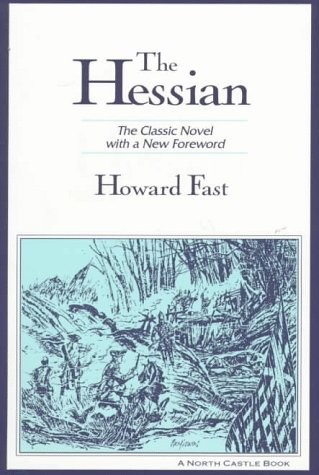
"When the Hessians had marched away and out of sight, Jacob Heather began to cry. There Was Saul Clamberham's body swaying in the soft wind...."
During the American Revolutionary War, the British hired German mercenaries called Hessians. One day during the war, they landed near Norwalk, Connecticut. Mistaking a retarded man, Saul Chamberham, who was following them for a spy, the platoon's officer immediately hung him. The scared and outraged local militia seek revenge. They cold-bloodily ambushed and killed all the Hessians except for a sixteen-year-old drummer boy who escaped. The wounded fugitive is found and hidden by a Quaker family. With the medical assistance of a cynical, Catholic doctor, the Hessian boy is nursed back to health by the kind, pacifist Quaker family. However, the local head honcho finds the boy and places him on trial for helping to hang the colonist. Ruled over by a buffoon of a general and a vicious, heartless prosecutor, the kangaroo court's verdict is guilty and the boy is expeditiously hung.
Library patrons or readers expecting a typical, inspirational, rousing Revolutionary War tale are always surprised. Perturbed at first, readers are easily gripped by the story told by a jaded and battle scarred doctor. The plot is enriched and deepened by a diverse assortment of characters. The author touches on marriage, Puritanism and religious tolerance, mob hysteria, nationalism, patriotism, justice, and the war casualty of morality--topics as relevant today as they were at the time of the Vietnam War. All this and more in less than two hundred pages! In 1972, it received the ALA Notable Book citation.
Because of the novel's theme, which is in sharp contrast to the better known April Morning (see my review), I've read of classes studying both novels because they represent different historical dimensions or points of view of the same war.
All of us book people have title lists and authors we believe have been unfairly forgotten. Howard Fast is one of mine. Of over fifty books published, his Citizen Tom Paine (1943), Freedom Road (1944),The Crossing (1971) and already mentioned April Morning (1961) are worth having in any collection. Blacklisted and jailed during the McCarthy hysteria, the author's Spartacus (1951) was self published, became a bestseller, and later became the Kirk Douglas movie.
There are a number of good Revolutionary War novels out there. Arundel and Rabble In Arms by Roberts are old reliables along with Edmonds's Drums Along The Mohawk. Bristow's Celia Garth still deserves mention. Jeff Shaara's Rise To Rebellion (2001), and sequel The Glorious Cause (2002), and Gingrich & Forstchen's To Try men's Souls (2009) and Valley Forge (2010) are fine, recent additions. The page turning and prolific historical novelist, Bernard Cornwell, never disappoints--see his Redcoats (1998) and just published The Fort (2010). Educators and librarians are probably familiar with YA titles such as the 1985 Newberry winner My Brother Sam Is Dead by Collier & Collier, Snow's Freelon Starbird (1976) and Finlayson's Silver Bullet (1978). Although difficult to come by other than via the used market, I'm still getting some checkout activity by boys with the Bruce Lancaster YA historical adventures written in the fifties and the 1960s biographical YA novels of Noel B. Gerson (The Swamp Fox) . Recommended by Robert L. Hicks, librarian