The late 19th century was a time of growing nationalism in Australia's colonies as Edmund Barton and his colleagues and supporters called for unification under Federation and. as well as the emergence of the Heidelberg School where a group of artists including Tom Roberts, Arthur Streeton, Frederick McCubbin, and Charles Conder were capturing iconic Australian outdoor scenes that focused on the unique light and colours of the landscape and the lives lived within them, so too were the wordsmiths - the "bush poets" - among them .Andrew Barton "Banjo ' Paterson. And, in 1890, he published what is perhaps his most iconic poem - The Man from Snowy River - which tells the story of the escape of a colt "worth £1000" who "joined the wild bush brumbies" and the chase that ensued to recapture him.
While some may argue that Waltzing Matilda is Paterson's most eminent work as it has become our alternative national anthem, The Man from Snowy River is still having a deep and divisive impact today as government investigation and legislation split the community, particularly that in the Kosciuszko region, between those with a sentimental connection to the role of the brumby in the area's heritage and those who see them as destroyers of the fragile alpine environment, to be culled by aerial shooting almost to extinction. While those in the high country town of Corryong hold an annual festival to pay tribute to the iconic stockmen, their horses, and the spirit of the Australian bush, and particularly Jack Riley, about whom the poem is said to be based, further north the division between the two schools of thought flares regularly whenever photos of brumby carcasses emerge or the issue is again debated in state parliament.
But for all the pros and cons, the fors and againsts, at the heart is a poem that has endured for over 135 years, which has been learned and recited ad infinitum by countless students over time, which has been put to music and made into a movie seen by millions, with a big-name director, big-name stars and a sequel!
No one who has seen that memorable clip from the movie as Burlinson races past his more experienced peers who have pulled up at the edge of the ravine and leaps over the edge will forget it, but while they are carried along by the heroics, the actions and the music, does anyone think about how the colt was feeling and faring?
https://youtu.be/3NBhLkavRFk?
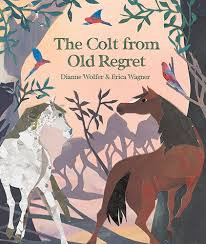
Enter this brilliant concept and beautiful piece of writing by Dianne Wolfer, renowned for her ability to take a snippet of Australian history and turn it into the most readable narrative such as Soaring with the Sugarbird Lady, bringing the stories of the past to life for a new generation. Accompanied by exquisite collages by Erica Wagner which echo the landscape I see out the window, this is not a retelling of that chase but a re-imagining of it from the colt's perspective as he flees through the bush with the stockmen in hot pursuit.
Using carefully chosen language, the odd snippet from the original, and those extraordinary illustrations the reader almost becomes the colt, experiencing the sights, sounds, smells and panic as he charges through the bush, whips cracking at his heels and where "the wild hop scrub grew thickly, and the hidden ground was full of wombat holes, and any slip was death" for both him and his pursuers. But while Paterson's poem ends with "the man from Snowy River is a household word today, And the stockmen tell the story of his ride", Wolfer has created a whole new ending that is one of joy and hope and comfort, making this one of the best books I have read and reviewed this year.
However, the book doesn't end with the ending of Wolfer's version for the original poem is included, also illustrated by Wagner's wonderful work, and then information about Paterson himself, Australian bush poetry, the brumbies, and the purported original man from Snowy River. But, more interestingly, there is the author's note that describes her connection to Australia's high country - for many who have been raised here, it is a landscape and a heritage that is in their DNA - and why the retelling was so important to her taking over six years to bring to fruition.
As well as connecting today's readers to such an important piece of Australia's literary heritage in a unique way, it also encourages them to consider point-of-view, perspective, and that there are at least two sides to every story. While for some time teachers have asked their students to consider the bears' side of Goldilocks, or the wolf's encounter with Little Red Riding Hood, given the emotions and debate associated with the 21st century issue of the brumbies in Kosciuszko National Park, this is one that could be used across all ages. As well as exploring the usual aspects of literature and literacy, the teachers' notes touch on this aspect by having students explore the introduction of brumbies, their impact and the author's intent, there is the potential for much deeper argument accompanied by justification and evidence - somewhat like the conundrum of whether Ned Kelly was a villain or a victim.
It's as though Wolfer has read, heard, seen and explored all the interpretations of the original but has been nagged by the question, "Whose voice has not been heard?" and has set out to redress this.
As a lover of Paterson's works this is one that is going to join my collection to be shared over and over again.
This review can also be found here.
Recommended by: Barbara Braxton, Teacher Librarian, New South Wales AUSTRALIA
48 pages 9781922507686 Ages 7 and up
Keywords: Australian history, wildlife, horses, point of view, perspective, empathy, difficult topics, 7 year old, 8 year old, 9 year old, 10 year old, 11 year old, 12 year old, poem
See more of her recommendations:
500 Hats http://500hats.edublogs.org/
The Bottom Shelf http://thebottomshelf.edublogs.org/
**********
Tossing his mane, the Colt from old Regret tears through the scrub. Stones clatter and crimson rosellas shriek as he canters higher.
You may have heard the story of the man from Snowy River and his fearless ride through the mountains. This is Colt's story, of nickering mares and a rearing stallion. How did Colt escape the man? What did Colt see, feel and smell as he charged through the bush?
Beloved children's author Dianne Wolfer responds to The Man from Snowy River, creating an essential companion to the original poem. It is illustrated with exquisite collages by Erica Wagner, which convey the depth of emotion with great tenderness. They encapsulate the mood of Wolfer's text, transporting the reader into the Snowy Mountains.
Endmatter includes the full text of Paterson's poem, along with additional information on Paterson himself, brumbies and the Snowy Mountains, and bush poetry. All gathered together, this is a new Australian classic in the making.---from the publisher
Editor's note: The Man From Snowy River poem tells the story of a man pursuing a horse through the wilderness of Australia. This narrative is told from the point of view of the horse and is based on the poem The Colt From Old Regret.