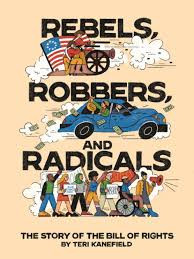
Meet the rebels, robbers, radicals, determined teenagers, and ordinary Americans who shaped our Constitutional rights.
The first ten amendments of the U.S. Constitution—known as the Bill of Rights—include the guarantee that no person may be deprived of life, liberty, or property without due process of law. Yet this soaring vision of human rights was written by enslavers who deprived others of these rights. The struggle to resolve this paradox continues to the present day.
From Teri Kanefield comes the story of the Bill of Rights, from the founding of America to the first sedition laws, slavery, women’s equality, the Civil War, Prohibition, the internment of Japanese Americans during WWII, the Civil Rights movement, gun control, and more.
Using real court cases, Kanefield explains the meaning of each of the first ten amendments. The result is the story of Americans who have tested the limits of their rights or demanded that their rights be recognized.
With full-color illustrations and thought-provoking text, Rebels, Robbers, and Radicals explores how our rights have evolved as the nation grew and changed.---from the publisher
224 pages 978-1419768262 Ages 10-14
Keywords: The Bill of Rights, U.S. Constitution, American history, human rights, social activists, 10 year old, 11 year old, 12 year old, 13 year old, 14 year old, Social Studies Curriculum
**************
“Number three
You have the right to free speech
As long as you're not
Dumb enough to actually try it”
– The Clash (1982)
“[T]he only thing that has truly served as an anchor of the United States of America is that we have been and, by the grace of God, we always will be a Christian nation.”
— Vice President J.D. Vance, recently speaking to more than 30,000 young
conservatives at Turning Point USA’s AmFest 2025
https://www.youtube.com/live/
Young readers will learn in REBELS, ROBBERS, AND RADICALS why Americans will never have to deal with the U.S. literally becoming a Christian nation. Let’s hope a bunch of those 30,000 young conservatives read this book and get the true facts.
In fact, any eighth grade American history student fortunate enough to be inspired or induced to read REBELS, ROBBERS, AND RADICALS will come away with some terrific history-related anecdotes, an enhanced understanding of basic American Constitutional law, and a mighty impressed teacher. For each of the ten amendments included in the Bill of Rights, veteran attorney and children’s author Teri Kanefield does an excellent job of encapsulating the colonial history that led to each of the amendments being included in the U.S. Bill of Rights. The author then provides valuable lessons through briefly summarizing the facts underlying court cases that have led to landmark Supreme Court decisions–decisions that direct how these amendments are to be interpreted and applied.
“The abolitionist movement in the United States gained momentum in the early nineteenth century. Slave states responded by passing laws limiting the speech of those who were enslaved and those who advocated for Black freedom. Mississippi’s slave code of 1857, for example, allowed for the death penalty or imprisonment with hard labor for up to twenty-one years for ‘using language having the tendency to promote discontent among free colored people, or the insubordination among slaves.’ A Georgia law outlawed ‘the assembling of [Black Americans] under the pretense of divine worship.’ The fear that slavers would use any public discussion of abolitionism to further terrorize their enslaved populations chilled speech about the issue.
At the same time, language that incited violence against Black Americans was tolerated and even encouraged by enslavers and law enforcement officers in slave states.
Abolitionist Wendell Phillips pointed out that restricting speech that advocated Black freedom meant that it was not possible to have a meaningful discussion about slavery. He said this was a problem because the drafters of the Constitution compromised on the issue of slavery, with the understanding that the issue would be left to the American people to resolve. Obviously, the people could not resolve the issue if they were not permitted to talk about it…
Because the First Amendment at the time applied only to the federal government, there was nothing to stop states from passing laws that restricted speech.”
The court cases cited—cases (in my experience) central to undergrad Constitutional history texts and curricula—provide clarity as to the importance and practical application of these amendments in our lives. The author includes just enough historical context and case law commentary for tween and teen readers to grasp the debates involved in the history, while keeping the book relatively short and sweet.
“Thomas Jefferson said he considered trial by jury ‘as the only anchor, ever yet imagined by man, by which a government can be held to the principles of its constitution.’”
Notably, there are also repeated discussions of the Due Process clause of the Fourteenth Amendment:
“No state shall make or enforce any law which shall abridge the privileges or immunities of citizens of the United States; nor shall any state deprive any person of life, liberty, or property, without due process of law; nor deny to any person within its jurisdiction the equal protection of the law.”
It was the post-Civil War adoption of the Fourteenth Amendment that led to the Supreme Court analyzing, in subsequent years, how the various clauses making up the Bill of Rights are fundamental rights that also apply to state governments’ actions and lawmaking, and not just to the Federal government.
The Supreme Court is–at this very moment–contemplating the meaning of another section of the Fourteenth Amendment:
“All persons born or naturalized in the United States, and subject to the jurisdiction thereof, are citizens of the United States and of the state wherein they reside.”
The Court will also, presumably, be debating the current
deportations-without-due-proce
In sum, given the history currently playing out, it'll really be a plus for young readers to learn how these amendments can directly and significantly affect the citizenship rights of their lives and/or their friends’ lives. The bottom line is that REBELS, ROBBERS, AND RADICALS is a great read and a must-have for middle school collections.
Recommended by: Richie Partington, MLIS, California USA
See more of Richie's Picks http://richiespicks.com/> http://richiespicks.pbworks.co