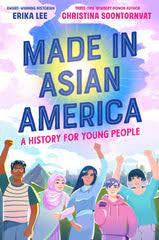
From three-time Newbery Honoree Christina Soontornvat and award-winning historian Erika Lee comes a middle grade nonfiction that shines a light on the generations of Asian Americans who have transformed the United States and who continue to shape what it means to be American.
Asian American history is not made up of one single story. It’s many. And it’s a story that too often goes untold.
It begins centuries before America even exists as a nation. It is connected to the histories of Western conquest and colonialism. It’s a story of migration; of people and families crossing the Pacific Ocean in search of escape, opportunity, and new beginnings.
It is also the story of race and racism. Of being labeled an immigrant invasion, unfit to become citizens, and being banned, deported, and incarcerated. Of being blamed for bringing diseases into the country.
It is also a story of bravery and hope. It is the story of heroes who fought for equality in the courts, on the streets, and in the schools, and who continue to fight in solidarity with others doing the same.
This book is a stirring account of the ordinary people and extraordinary acts that made Asian America and the young people who are remaking America today.---from the publisher
320 pages 978-0063242937 Ages 10-12
Keywords: Asian and Asian American, American history, immigrants, immigration, prejudice and racism, heroes, bravery, 10 year old, 11 year old, 12 year old
********
“Lawmakers and media personalities were using racist terms to describe the virus and blame Chinese people for the spread of the disease. The president of the United States at the time even called it ‘the Chinese virus.’ New Jersey high school junior Kyler Zhou was at soccer practice when he was told that he and ‘his people’ had caused the pandemic. All over the country, Asian Americans were experiencing a rise in racist and violent encounters.”
Imagine all the people
Livin' life in peace
– John Lennon (1971)
I was unaware of so many of the figures and significant events that are vividly brought to life in BORN IN ASIAN AMERICA: A HISTORY FOR YOUNG PEOPLE. This is my kind of book in so many ways. I’m blown away by the breadth of research and quality of the writing these two notable authors (a Harvard Law professor and a 3X Newbery Honoree) have poured into this compilation of the history of Asian-Americans–and Asian hatred–in America. Much of the history is seen from the perspective of impacted young people. From beginning to end, this chronicle is fascinating and readable. And pretty damned heartbreaking a lot of the time.
Did you know that here in San Francisco–a decade before the high Court’s racist “separate-but-equal” ruling in Plessy v. Ferguson–the San Francisco school board argued that they could exclude American kids with Asian heritage from public education? In the face of an adverse court ruling, they hastily erected separate-but-unequal schools for those students.
BORN IN ASIAN AMERICA is a book that is thoroughly accessible to a ten-year-old reader, while being so rich in content that it will readily hold the interest of sophisticated teen readers. As a retired educator, and as a longtime proponent of No Name-Calling Week, I will be rooting hard for this one to win a bunch of awards and find its way into lots of school libraries and classrooms. Whether it’s white, Black, or Asian-American young readers, this is a book that will serve well in enlightening a new generation as to how, throughout American history, prejudice, hate, and greed have combined to the detriment of those who were not white, male, and Christian.
“During his two years as president, he [LBJ] had already signed some of the most significant legislation in US history, including the 1964 Civil Rights Act, which made it illegal to discriminate against someone based on race, color, religion, sex, or nationality. Just two months prior, he had signed the historic Voting Rights Act into law, which outlawed discrimination that had been used to keep African Americans from voting.
Through marching, protesting, petitioning, and putting their own lives on the line, African American civil rights activists had pressed the American public and their president to make changes toward a more just and equal America.
President Johnson and other leaders in the US saw the new immigration act as an extension of the civil rights legislation they had passed. They pointed out that this new immigration law would undo the decades of discriminatory policies that had shut out so many. It would be fair, and it would make good on the promise of America that everyone should be equal. But the president was also quick to assure folks that even though the law was a great thing, nothing major was going to change. He did this because he knew that plenty of people were not going to like it.
The same people who opposed civil rights for African Americans also pushed back against any changes to immigration. They claimed that without race-based immigration barriers, America would be overrun by ‘hordes’ of Africans or Asians, or become a ‘dumping ground’ for migrants from Latin America.
There are too many of them.
Opponents to immigration argued that if the United States opened its doors to more immigrants, the country would become less white. For them, America was a white country, and it should stay that way.
For decades, US immigration law had excluded immigrants based on a person’s race or where they were from. During the 1930s and into World War II, American lawmakers would not even change the rules to allow Jewish refugees into the country to escape extermination by the Nazis. Only a small number were able to enter. And in fact, Nazi Germany’s leader, Adolf Hitler himself, admired the racism of America’s immigration laws. They excluded the ‘foreign body’ of ‘strangers to the blood’ of the ruling (Nordic-German) race, he wrote in an unpublished sequel to Mein Kampf. He commended the US for its actions.
When Hitler is praising your immigration laws, it’s not a great sign.”
And when Donald Trump enthusiastically makes points about Asians and Asian-Americans that recall Hitler’s goals and policies, that would not seem to be a very good sign, either.
Recommended by: Richie Partington, MLIS, California USA
See more of Richie's Picks <http://richiespicks.com/> http://richiespicks.pbworks.co