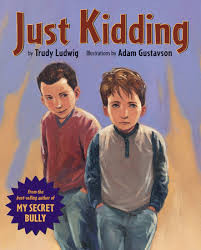
A rare look at emotional bullying among boys from the best-selling author of My Secret Bully.D.J.'s friend Vince has a habit of teasing D.J. and then saying, Just kidding!" as if it will make everything okay. It doesn't, but D.J. is afraid that if he protests, his friends will think he can't take a joke. With the help of his father, brother, and an understanding teacher, D.J. progresses from feeling helpless to taking positive action, undermining the power of two seemingly harmless words. Trudy Ludwig takes another look at relational aggression, the use of relationships to manipulate and hurt others, this time from the boy's point of view.
- Back matter includes discussion questions, a "dos and don'ts of teasing" list, and a resource guide for parents and teachers.
- Endorsed by Full Esteem Ahead, The Hands & Words Are Not For Hurting Project, and The Ophelia Project.---from the publisher
32 pages 978-1582461632 Ages 7-11
Keywords: bullying, emotional bullying, boys' issues, teasing, power of words, manipulation, point of view, relationships, aggression, social skills, understanding your feelings, understanding yourself, self respect, 7 year old, 8 year old, 9 year old, 10 year old, 11 year old, Social Emotional Learning Curriculum
Read alikes: My Secret Bully; The Not So Friendly Friend; Better Than You; Sorry by Trudy Ludwig
*******
Other reviews:
Waiting to be chosen for a pickup game of basketball, D. J. hears Vince challenge Cody to a game of Rock Paper Scissors: "Loser gets D. J." It's not the first time Vince has crossed the line, but D. J. can't figure out how to respond. With a helpful suggestion from his dad and support from a teacher, D. J. begins to handle his problem. The story offers a realistic portrayal of a bully who uses words in hurtful ways but avoids punishment. It also offers hope that children can break the pattern, at least if the adults around them are aware of the problem, competent to deal with it, and supportive of the children involved. The book concludes with a list of "Teasing Dos and Don'ts" for kids. In addition, a detailed foreword offers suggestions to parents and teachers trying to help children in this situation. The well-composed illustrations, apparently acrylic paintings, offer sensitive portrayals of children in realistic settings. Pair this with Becky Ray McCain's Nobody Knew What to Do (2001). Carolyn Phelan