978-0-8027-2277-5
"If you hear the song I sing
You will understand
You hold the key to love and fear
In your trembling hand.
Just one key unlocks them both
It's there at your command"
-- Chet Powers "Get Together"
During WWII, the fear of everyday Americans whose appearance was
"different" led to a massive hate crime perpetuated by the United States against
more than 120,000 of its own people, revealing that our "more perfect union"
operates far from perfectly when the country is overrun with racists.
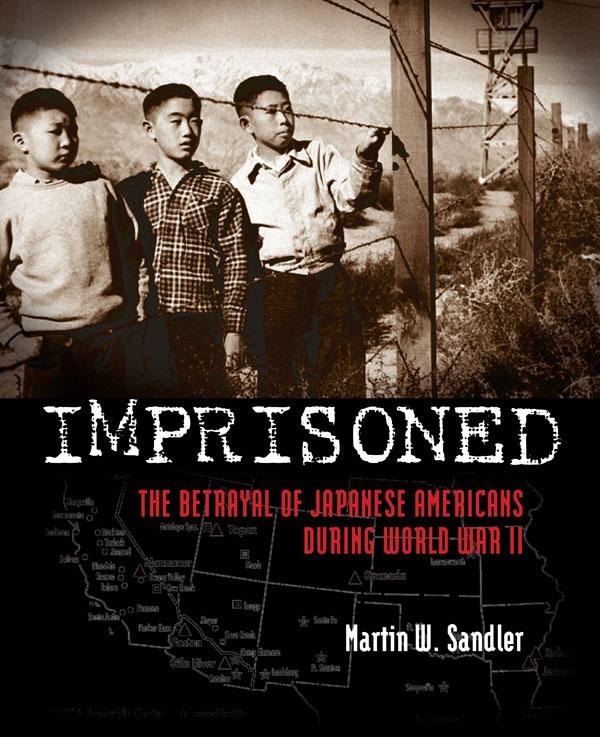
IMPRISONED: THE BETRAYAL OF JAPANESE AMERICANS DURING WORLD WAR II is an
excellent and horrific account of this dark chapter in American history, and
a book that I wish I'd encountered as an adolescent.
"The idea of hastily rounding up all Japanese Americans and placing them
in what amounted to prison camps was a direct and outrageous violation of
the supreme law of the United States, as set out in the US Constitution.
More specifically, it was a violation of vital personal rights guaranteed by
the first ten amendments to the Constitution, known as the Bill of Rights,
which among other liberties, provides that:
'Any person accused of committing a crime has the right to be told what
crime he or she is being charged with having committed.'
'Any person accused of committing a crime has the right to a speedy, fair,
and public trial to determine whether a crime has been committed.'
'At this trial, the person charged with the crime has the right to have
the assistance of a lawyer to defend him or her, and the right to have
witnesses testify on his or her behalf.'
"It was these and other guarantees that had earned America the title 'Land
of the Free.' Yet those who wanted the Japanese Americans -- the majority
of whom were US citizens -- removed were willing to ignore these cherished
rights."
This questions that must be asked all these years later are: What caused
Americans to behave in this manner? When else has our country behaved in
such a hatefully prejudiced, immoral, and illegal manner? What can we do to
better educate our children so that they forcefully stand against such
behavior when it next arises in their lifetimes? This book provides a lot of
information that is really useful in answering these questions.
There were, indeed, some who opposed the Japanese internment:
"Lieutenant Commander K. D. Ringle of the Office of Naval Intelligence had
searched diligently for instances of the sabotage or espionage allegedly
carried out by Japanese Americans. He had failed to find a single example.
In a memorandum intended for top government leaders, he wrote, 'The entire
Japanese problem has been magnified out of its true proportion largely due
to the physical characteristics of the people.' The memo was never
released.
"James J. Martin, one of the nation's leading historians, was truly
alarmed. The intention to deprive Japanese Americans of their liberties by
removing them from their homes and means of livelihood was, he would write
later, 'a breach of the Bill of Rights on a scale so large as to [be worse than]
all such violations from the beginning of the United States.
"The FBI, the first government agency given the task of identifying
disloyal Japanese Americans, testified at government hearings that those of
Japanese ancestry 'were fundamentally loyal and, as a group, posed no threat to
the nation's security.' In a letter to U.S. Attorney General Francis
Biddle, Hoover wrote that the cries for removal were 'based primarily upon
public and political pressure rather than factual data.'"
We also learn that Quaker groups such as the American Friends Service
Committee protested the planned internment and then, during evacuation, tried
to mitigate some of the damage being done.
But the reality is that the failure of the vast majority of Americans to
oppose this radical, unconstitutional, and immoral course of action, this
giving in to prejudice and hatred and fear, makes most adult Americans living
in those days co-conspirators in this crime.
And the crime was compounded over successive decades by those who
participated in successfully hiding it from school children of my generation,
stealing from us the benefits of learning from that generation's stupidity. (I
spent last night contacting a bunch of old friends. Not a one of us had
learned about the Japanese American internment in high school.)
In the process of providing visual depictions of what Japanese Americans
had to endure in those years, author Martin W. Sandler also introduces
readers to photographer icons Dorothea Lange and Ansel Adams.
So, how do we prevent more such crimes from being committed by the
majority against a minority?
I think that we have to begin early. Several years after its publication,
I am still feeling that far too many missed the boat on the brilliance and
importance of Mo Willems' CAT THE CAT, WHO IS THAT?, an oh, so perfect and
simple story about how we should assume that, no matter how different from
you someone looks, they are a friend. Start there and gradually and
honestly teach the many examples of America gone wrong, including that of the
Japanese American internment.
C'mon people now, smile on your brother. As I was reminding a bunch of
seventh graders to whom I was book talking this one yesterday, down inside
where it counts, we're a million times more similar than we are different.
It was a crime that Americans didn't stand up for one another and stand
against hatred in 1942.
Seventy-one years later, at a time when we are debating the possibility of
bombing some homicidal tyrant (and a bunch of innocent bystanders) in
retaliation for his gassing his countryman, we best be sure we've first learned
and are adequately teaching our kids the lessons of America's own past
transgressions, beginning with the Japanese American internment, before we go
deciding that we are the revengers of the world.
176 pages 978-0-8027-2277-5
Recommended by: Richie Partington, MLIS, Librarian, California USA
Richie's Picks _https://richiespicks.com_ (https://richiespicks.com/)