"It is staggering, in the Internet age, to realize how much criminal
activity and corruption was successfully hidden from public view at the turn of
the twentieth century. According to one veteran newsman, McClure's exposed
trusts, gangs, political bosses, vice rackets, and corruption, but above
all 'exposed our lack of a national journalism.' Ray Stannard Baker claimed
that '[the] ignorance [of citizens] causes most of our problems.'
McClure's came through, with long, complex, well-researched, and intelligently
argu
ed articles. Americans in an era without radio, television, or the
Internet read them with interest. So did the government. In 1906, the U.S.
attorney general began to prosecute Standard Oil under the Sherman Antitrust
Act."
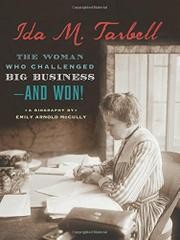
Ida M. Tarbell was the author of these history-changing articles in
McClure's. Her ability to research and write them helped attract to McClure's
other rising stars like Lincoln Steffens. Emily Arnold McCully's biography
of Ms. Tarbell, which is filled with horrific tales of U.S. imperialism; of public policy (both domestic and international) being driven by corporate interests; of a heartbreaking disparity between rich and poor; reveals the unusual life of this woman who was an investigative rock star in an age of men, and also reveals an America back then that seems in so many ways toshare similarities with America today.
"You who are on the road
Must have a code that you can live by"
-- Graham Nash, "Teach Your Children"
How and why did Ida M. Tarbell follow what was -- for a woman in that era
-- such a groundbreaking path? Why was she the right writer to plumb the
depths of Standard Oil and be able to successfully expose Rockefeller's
empire for what it was? I love how McCully -- who grew up the daughter of a
journalist who revered Tarbell -- takes us through Tarbell's unusual
childhood that so readily foreshadows on several levels the uncompromising
adulthood road the author's subject would take.
"For a girl devoted to reason, science would almost certainly win out over
faith. Science, exciting and dangerous, engaged Ida's developing
intellect, while in her opinion faith required only passive submission. Ida was
constitutionally incapable of hypocrisy, so she concluded she'd have to leave
the church. But what could replace it? Every value she tried to live by
came from the Bible. All the Tarbells were acutely, if inarticulately,
aware of each other's sensitivities. The family kept conflict at bay adhering
to the precepts of 'Do unto others' and 'Turn the other cheek,' which were
Christian, not scientific. Science offered no such moral guidance.
"Ida cared deeply about being good. How was science going to help her?
She didn't know. She'd been emptied of belief and filled with terrible
doubt. But having to find answers on her own would eventually build intellectual self-confidence. Science did offer something momentous and lasting: the pursuit of knowledge.
"How had life begun? How did things grow and change? Ida decided that
she needed a microscope to examine life at its most elemental; she might even
learn the secret of creation. She saved her money and bought one. Then
she begged to be given the tower room at the top of the house for her
laboratory. From now on, she would verify anything she was told. On the floors
below, her family still believed that the world had been created in six
days."
Not only did Ida M. Tarbell have to surmount the institutional barriers
that held women back from becoming
anything not acceptable to the white males
who controlled everything, but she had to do her work often hamstrung by a
brilliant and mercurial boss who today "might be diagnosed as bipolar with
attention-deficit disorder." And so it was that Tarbell necessarily had to
take charge at McClure's on several levels in order to succeed in
enlightening the pre-mass-media provincial America in which she dwelled.
"President McKinley told the nation he had prayed for guidance in dealing
with the conquered peoples. He reported this revelation: 'Educate, and
uplift and civilize and Christianize them,' and assured his constituents that
after resolving to put it into effect, he 'went to bed and went to sleep
and slept soundly.'"
And as utterly backward and unenlightened as I, for one, find that
particular point of view, we learn that Ida Tarbell held some equally bizarre
views -- particularly about women -- that will make many twenty-first century
readers scratch their heads.
As an activist and as a lifelong student of American history, I found
Emily Arnold McCully's biography of Ida M. Tarbell to be filled with fascinating parallels between then and now that are just waiting to be discovered by young readers, and overflowing with history, concepts and questions that will intrigue and inspire and compel discussion.
288 pages 978-0-547-29092-8
Recommended by: Richie Partington, Librarian, MLIS, California USA