
With their unflappable expressions, large, striking eyes, and cuddly appearance, capybaras are undeniably cute and appealing. They’re intelligent and emotionally sensitive and one of the world’s most loved and recognised animals. These charming creatures are easy-going and are well-known for being one of the most friendly and sociable animals on the planet.
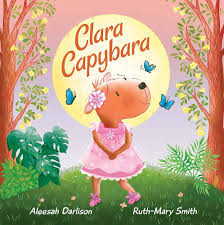
In Clara Capybara, young Clara – like the rest of her species – is friendly and amiable and loves to please others. But with her ‘can do’ attitude, it’s easy for Clara to be taken advantage of. When Clara finds herself unable to say no to the constant demands on her time, Mama imparts some wise words to help Clara implement a plan that involves diplomacy and better self-care.
Carrying essential themes of self-care, mental health, diplomacy, navigating relationships, manners, setting boundaries, and social anxiety, Clara the Capybara possesses layers of meaning that will appeal to both children and adults. Woven into the story are language and literacy elements teaching synonyms and alliteration and, of course, a study in the nature of delightful capybaras.---from the publisher
32 pages 978-1761111952 Ages 3-6
Keywords: capybara, animals, sensitivity, boundaries, saying no, self care, mental health, social skills, social situations, social anxiety, synomyms, alliteration, 3 year old, 4 year old, 5 year old, 6 year old
********
There are many ways to say the word "yes" - okay, of course, okey-dokey, certainly, my pleasure, absolutely - and Clara Capybara knew them all. Not only did she know them all but she used them all as she constantly acceded to her friends' requests, even the unreasonable ones, because she had forgotten how to say no.
It gave her a warm, fuzzy feeling inside to help them because she felt she was needed and the pinnacle was receiving "The Most Helpful Student Award" at school. In fact, she was so afraid that her friends wouldn't like her anymore if she didn't agree, that she spent all her time meeting their needs and not taking care of her own. That innate sense to please those whose approval we want not only drove her but, indeed, she believed, defined her. Even her mother was concerned enough to tell her to do something for herself instead, but can Clara find the courage to say no? And will her friends still be her friends if she does?
Given the current interest in capybaras by many of our young readers, and cleverly using the natural highly sociable nature of the species, Darlison has created a story that will provoke a lot of thought and discussion about the nature of friendship, and that it is more than just pandering to the demands of those whose attention we want. It's an opportunity to consider what else underpins those relationships that are important to us as well as understanding the old saying, "If we don't take care of ourselves, we can't take care of others." At the same time, while Clara learns to say, "No," she (and the readers) learn that it can be done politely and diplomatically, framed in a way that no one is offended and there is scope for the friendship to continue. Friendship is about give and take on both sides.
While many stories for young readers focus on social and emotional development as they move from the comfort zone of family, this one also provides the opportunity to delve deeper and consider how Clara's willingness to always be there help might be disempowering her friends. Is Clara's need for the approval of her friends selfish because she is not allowing them to learn and grow and be independent? If she doesn't comb Fox's ears or tie Toucan's shoelaces, would they learn to do it for themselves? If she doesn't help with Parrot's homework, will he have to put in extra effort? If she doesn't lend her dress to Cheetah, how will Cheetah learn to cope with disappointment? If our students don't face negatives like failure, disappointment and frustration, how will they develop the strategies to cope with them when they inevitably do? Sometimes setting boundaries for ourselves opens opportunities for others.
Although this book may catch the eye because of its striking cover and the popularity of its main character, in true Darlison style, it offers much more that the surface storyline suggests.
This review can also be found here.
Recommended by: Barbara Braxton, Teacher Librarian, New South Wales AUSTRALIA
See more of her recommendations:
500 Hats http://500hats.edublogs.org/
The Bottom Shelf http://thebottomshelf.edublogs.org/